
Kickometry: How We Build Specialists
Kickometry bridges the gap between raw talent and measurable performance. Founded by Coach Lundy on the laws of geometry and physics, Kickometry breaks down every kick, punt, and snap into actionable data. By combining isolated field-training activities with elite TrackMan technology, we help specialists analyze their technique, timing, and mindset to eliminate inconsistencies and accelerate growth.
Because training is never one-size-fits-all, we build a personalized process around your unique mechanics and goals. We isolate your specific areas of improvement, educate you on the exact methods needed to overcome those issues, and establish a clear baseline. From there, we define your standards, measure your data, and build repeatable excellence when it matters most.
2004coaching specialists since
150+scholarships earned
Reached the NFLCairo Santos · Garrett Hartley · Caleb Sturgis · Matt Wright · Tommy Townsend · Johnny Townsend
The Language of Kickometry
Every correction refers back to a small set of checkpoints. These are the terms your athlete will hear on the field.
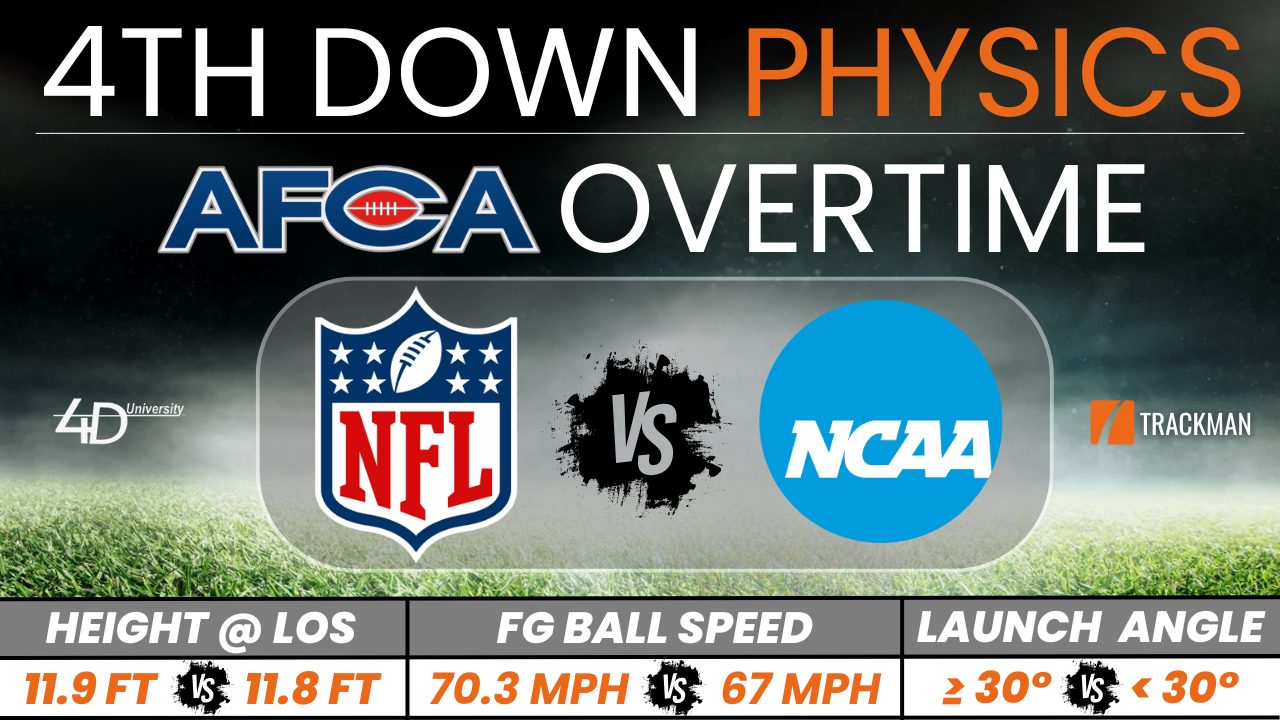
KS Knee — the kick-side knee. For a right-footed kicker, the right knee. Delaying that knee is vital to an effective launch angle, and launch angle is what determines whether the ball clears the line of scrimmage and has a chance at three points.
The Alley — staying in your lane. Linear through the approach and through the ball, instead of drifting across it.
The 11:30 Rule — the angle of the ball as it is dropped to the foot. At 12 o’clock you catch the butt of the ball and get end-over-end rotation. At 10 o’clock it flies sideways, which costs you both distance and hang time. 11:30 is the window.
The Kinetic Chain. Not our term, but central to how we teach: how the body moves progressively, and the sequence of events that determines functional movement.
Film First. Data Second.
Kickometry started on a phone, not a launch monitor. On-field film analysis is still the core tool and the catalyst for every correction we make — it has been the foundation of this program far longer than TrackMan, which joined it in 2023. The camera shows what the athlete did. The data shows what it produced. You need both, and you need them in that order.
Repeatable Beats Talented
Anyone can hit one good ball. The job is shrinking the gap between the best rep and the worst one. We call that gap plus/minus, and lower is always better. It is the number that decides whether a coach trusts you in a one-score game, and it is the number most specialists never measure.
Hang Time Over Distance
Be careful chasing distance. A 50-yard punt with 4.0 hang is worse than a 40-yard punt with 5.0. The first one hands the most electric athlete on the other team space and time with the ball. The second denies him both, and the coverage pressure it creates is what forces the fumble. Distance is the number that impresses people. Hang time is the number that wins the down.
Operation Is a Team Skill
A snap, a hold and a kick are one action, not three. We train the operation as a unit and time it as a unit — and every operation number assumes protection is sound. A fast operation behind a broken pocket does not mean anything.
High School Operation Targets
Assumes sound protection, guard to end:
| Operation | Target |
|---|---|
| Field goal — snap to kick | 1.3 sec |
| Field goal — hand to hand, snapper to holder | 0.5 sec |
| Punt — hand to hand, from 15 yards | 0.8 sec |
These are targets, not ceilings. Above high school the standard stops being a time to beat and becomes consistency of speed and location — which is why we grade the spread across ten reps rather than the best one.
A Word on How These Are Timed
Most snap times you see quoted are hand-timed, and stopwatches plus human reaction have inflated those numbers for years — largely for recruiting. Electronic timing tells a different story. Very few snappers are genuinely under 0.8 seconds from 15 yards, and fewer still are under 0.8 with great location. A snapper who is both will get a lot of looks at the Saturday level.
Where Do Your Numbers Land?
Put your ball speed, hang time, distance or operation times into the interactive tool and it will tell you which line they sit on.
The Standards Below Are Destinations, Not Grades
The tables on this page are built from more than 600,000 NFL, NCAA and high school kicks and punts. They are not a high-school ladder. They describe what a specialist looks like at the level he wants to reach — NFL, Power 4, D1, D2/D3 — so an athlete can see the gap between where he is and where he is trying to go, measured the same way college programs measure it.
One caution when you read them: field goal and kickoff ball speed are different measurements, so grade every kick against the line for its own drill.
TrackMan Standards
600K+ NFL, NCAA, & HS kicks & punts
Field Goal
| Level | Ball Speed (MPH) | Good From (YDS) | Launch Angle (DEG) | LOS Height | Accuracy | Apex (FT) | Spin Consistency |
|---|---|---|---|---|---|---|---|
| NFL | 72 | 60 | 30-31 | 11'9" | 85+ | 45 | <75 +/- |
| P4 | 69 | 57 | 29-31 | 11'8" | 80+ | 42 | <90 +/- |
| D1 | 67 | 53 | 28-32 | 11'5" | 75+ | 39 | <110 +/- |
| D2/D3 | 65 | 50 | 27-33 | 11'0" | 70+ | 35 | <130 +/- |
Punt
| Level | Distance (YDS) | Hang Time (SEC) | Ball Speed (MPH) | Launch Angle (DEG) | Apex (FT) |
|---|---|---|---|---|---|
| NFL | 48 | 4.8 | 65 | 52 | 80 |
| P4 | 46 | 4.6 | 63 | 50 | 75 |
| D1 | 42 | 4.2 | 61 | 48 | 67 |
| D2/D3 | 40 | 4.1 | 58 | 45 | 60 |
Kickoff
| Level | Distance (YDS) | Hang Time (SEC) | Ball Speed (MPH) | Max Speed (MPH) | Launch Angle (DEG) | Apex (FT) |
|---|---|---|---|---|---|---|
| NFL | 71.0 | 4.1 | 80.0 | 92.0 | 30.0 | 55.0 |
| NCAA | 68.0 | 4.0 | 77.5 | 89.0 | 30.0 | 51.0 |
Data via TrackMan / The Tour
Coach Presentations
 |
 |
Questions? Talk to Coach Lundy